
Licensing Overview
Each educator license has a license area; some have an endorsement to indicate a specialization in a content area or particular set of skills.
A helpful way to think about a Utah educator license is as a tree:
- The license is the trunk.
- The license areas (such as Elementary Education, Secondary Education, or School Counseling) are the branches.
- Endorsements, such as History or Secondary Mathematics, are the leaves.
Educator License Levels
There are three educator license levels.
- Professional
All of the requirements have been met and competencies demonstrated. - Associate
A minimum number of requirements have been met and/or competencies demonstrated. - Local Education Agency (LEA) Specific
Under direction of the local governing boards of school districts or charters.
License Areas
These indicate which grade levels you are qualified to teach or service you are qualified to provide in Utah public schools.
License Area
Grade Levels
Possible Positions
Note: Positions vary by school
Career and Technical Education (CTE)
Grades 9-12
Automotive Technology Teacher*
Cosmetology Teacher*
Woods Teacher*
Deaf Education
Kindergarten-Grade 12
High School Teacher of the Deaf*
Itinerant Listening and Spoken Language Teacher*
Third Grade Teacher of the Deaf
Early Childhood Education
Pre-Kindergarten-Grade 3
First Grade Teacher
Reading Specialist*
Title I Preschool Teacher
Elementary Education
Kindergarten-Grade 8
Elementary Interventionist
Kindergarten Teacher
Middle School Math Teacher*
Preschool Special Education
Preschool/Pre-Kindergarten
Individualized Education Program (IEP) Case Manager for 4-year-old class
Preschool Special Education Teacher
School Counselor
Kindergarten-Grade 12
Career Center Director
Elementary Counselor
High School Counselor
School Leadership
Kindergarten-Grade 12
Assistant Principal
Principal
School Psychologist
Kindergarten-Grade 12
School Psychologist
School Social Worker
Kindergarten-Grade 12
School Social Worker
Secondary Education
Grades 6-12
High School Science Teacher*
Middle School Art Teacher*
Student Government Advisor
Special Education
Kindergarten-Grade 12
Elementary Special Education Teacher
Middle School Math Co-teacher
Self-Contained Resource Teacher
Speech Language Technician
Kindergarten-Grade 12
Speech Language Technician
*=These positions require an additional endorsement to be fully qualified.
Pathways to a Professional Educator License
Utah offers three distinct pathways for aspiring educators to earn a Professional Educator License. Whether you are a traditional student, a career changer with a degree, or an aspiring educator working in a classroom, there is a route designed to fit your background.
Path 1: Standard University Preparation Program
This is the traditional route to becoming a teacher. You enroll in an approved university or college teacher-education program.
Path 2: Alternate Pathway to Professional Educator License (APPEL) Program
This alternative route lets you teach in a classroom while you complete your training through your local school district.
Path 3: Utah Registered Apprenticeship Program for Teachers (U-RAPT)
This is an "earn-and-learn" model. It allows you to work directly with students while taking classes to finish your teaching degree
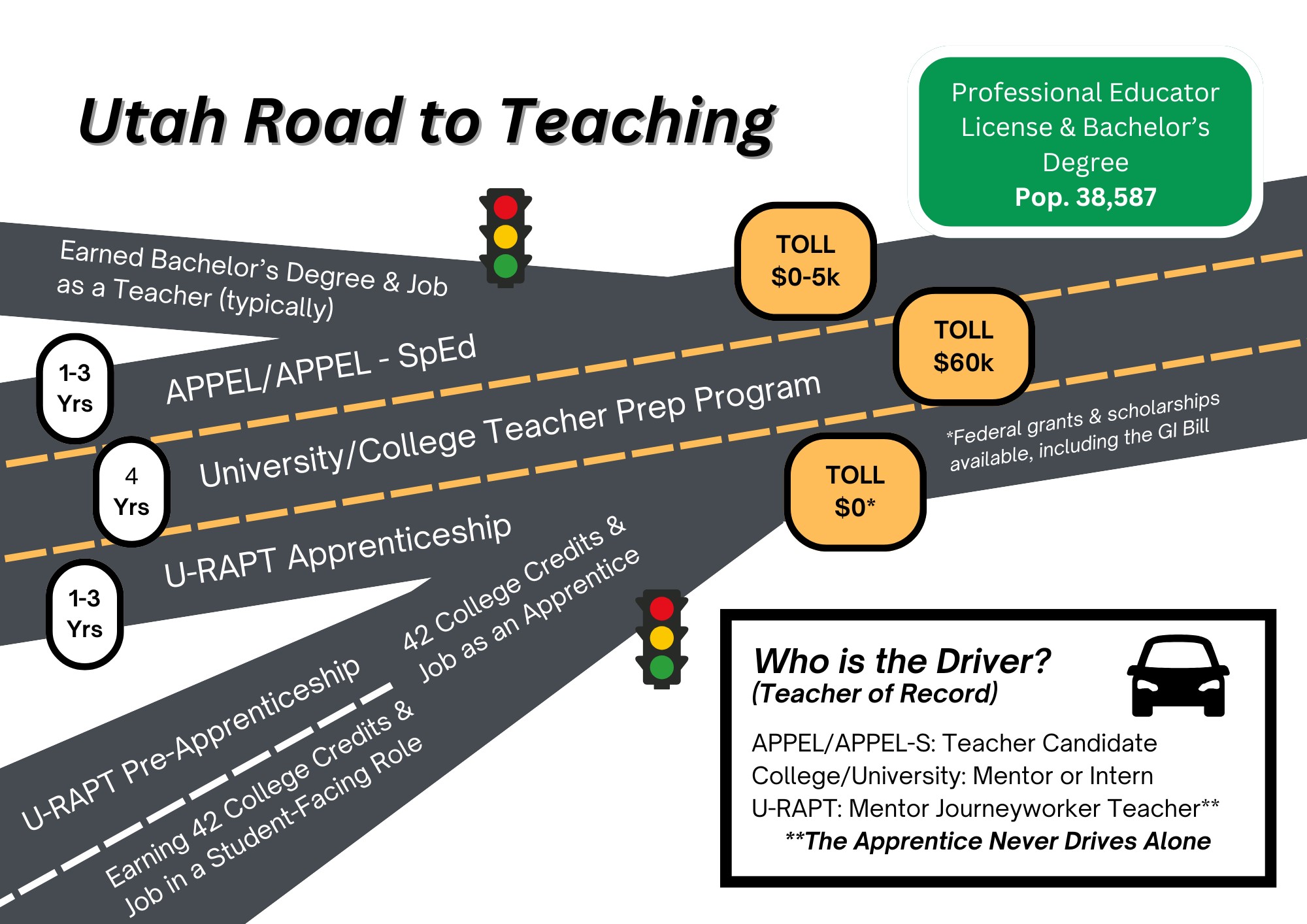
Earning Your Utah Teaching License Through a University Program
A traditional university educator preparation program is a structured, college-based pathway to becoming a licensed teacher. In this program, you complete your university degree and your teacher training at the same time.
If you choose this route, you will complete your training before you become the primary teacher in your own classroom.
How the Program Works
Traditional programs are divided into three main components:
- Coursework: You take college classes focused on the specific subject you want to teach (such as math, history, or biology) as well as classes on teaching strategies, classroom management, and child development.
- Field Experience: Early in your program, you will spend time observing experienced teachers in local public or charter schools and assisting with small-group activities.
- Student Teaching: During your final semester, you will work full-time in a local classroom. Under the guidance of a mentor teacher, you will gradually take over planning and teaching the lessons.
What You Earn Upon Completion
When you graduate from an approved university program, you receive two things:
- A bachelor’s or master’s degree in education or your specific subject area.
- An institutional recommendation for licensure, which tells the Utah State Board of Education (USBE) that you have met all state standards and are ready to receive your Professional Educator License.
Is a University Program Right for You?
Consider a traditional university program if you prefer to master teaching skills in a supportive, supervised environment before managing a classroom on your own.
Benefits
- Clear Structure: The program follows a defined, step-by-step graduation checklist.
- Strong Support: You receive ongoing feedback from both university professors and your classroom mentor teacher.
- High Marketability: School districts highly value candidates who have completed a full student-teaching internship.
Key Considerations
- Time Commitment: These programs typically require a full-time commitment of 4 years for a bachelor's degree.
- Training: Student teaching is a full-time, semester-long commitment which can make working an outside job difficult. The State of Utah provides financial stipends of up to $6,000 per student to help support university and college students while they complete their student teaching in a Utah public school. Learn more at the Student Teacher Stipends page.
Utah Educator Preparation Programs
There are ten university-based Educator Preparation Programs (EPP) offered in Utah. Each institution has a variety of programs and degrees available.
- Brigham Young University, Provo, Utah
- Rocky Mountain University of Health Professions, Provo, Utah
- Southern Utah University, Cedar City, Utah
- University of Utah, Salt Lake City, Utah
- Utah State University, Logan, Utah\
- Utah Tech University, St George, Utah
- Utah Valley University, Orem, Utah
- Weber State University, Ogden, Utah
- Western Governors University, Salt Lake City, Utah
- Westminster University, Salt Lake City, Utah
Out-of-State Teacher Preparation Programs
If you completed your educator preparation program at a university outside of Utah, you must follow a two-step process to get your Utah professional educator license:
- Get your license in that state first: You must first obtain your official educator license from the state where your university is located.
- Apply in Utah: Once you hold your out-of-state license, apply for your Utah license by submitting a License Equivalency Review (LER) application.
Why this matters
The Utah State Board of Education cannot issue a license based directly on an out-of-state university graduation. Your license must first be active in the state of your training before it can be transferred to Utah.
Alternate Pathway to Professional Educator License (APPEL) Program
The APPEL program is an alternative teacher preparation pathway approved by the Utah State Board of Education (USBE). It allows you to earn your professional Utah teaching license while working as a paid teacher.
To become a licensed educator through Utah’s APPEL program, you must apply directly to an approved program. Because requirements vary by program, review the steps below to get started.
Meet the Basic Eligibility Requirements
Most APPEL programs require you to be employed by a Utah school district or charter school that partners with an approved program.
Each program sets its own specific admission criteria. You can view all options on the USBE Approved APPEL Programs List.
Check the License Requirements for Your Program
Programs differ on whether you need an Associate Educator License (AEL) before you apply:
- Some programs require an AEL before they will accept you.
- Some programs allow you to apply without an AEL and will help you get one later.
Important Note: Getting your AEL does not automatically enroll you in a school or district APPEL program. You must still submit an application directly to the program director.
If you need to obtain an AEL first, follow the instructions on the USBE Associate Educator License Application page.
How APPEL Works
Contact a Program Director
Because admission requirements vary, contact the director of your preferred program directly to verify their specific deadlines, prerequisites, and application steps.
Utah Registered Apprenticeship Program for Teachers (U-RAPT)
U-RAPT is a paid, competency-based program that allows you to earn a teaching degree and professional Utah teaching license while gaining paid, hands-on experience in a classroom. The program is built on equal opportunity and emphasizes demonstration of real-world teaching skills.
The program is divided into two distinct phases depending on your current level of education.
Phase 1: Pre-Apprenticeship
Who it is for: Individuals who do not yet have a college degree but want to pursue a career in education.
In this phase, you will:
- Work toward earning an associate degree.
- Gain 1 to 2 years of paid, on-the-job classroom experience.
- Learn foundational skills side-by-side with a qualified mentor teacher (journeyworker).
Phase 2: Apprenticeship
Who it is for: Individuals who already hold an associate degree (or equivalent college credits) and want to become fully licensed teachers.
In this phase, you will:
- Work toward earning your bachelor's degree and a professional teaching license.
- Complete 1 to 3 years of paid, on-the-job classroom training.
- Partner directly with a qualified mentor teacher (journeyworker) to master and demonstrate core teaching skills.