Utah First Credential Program
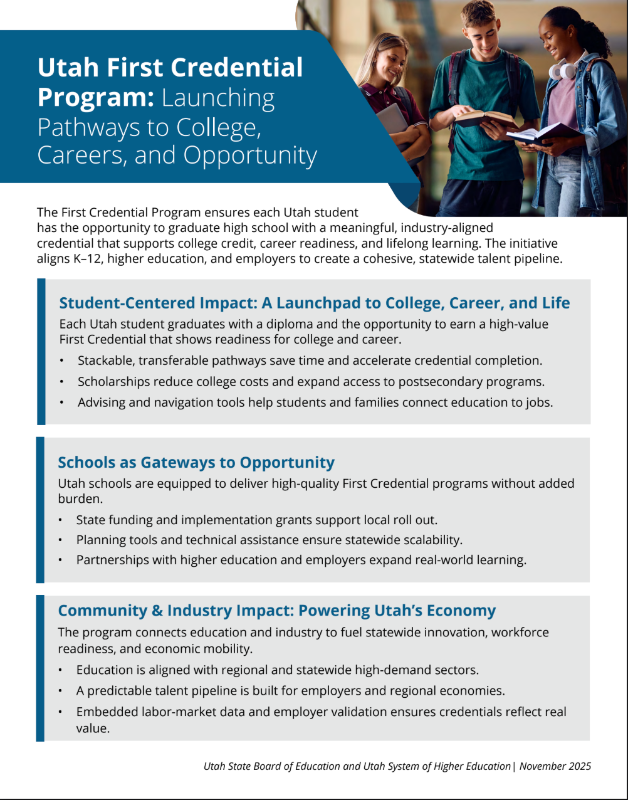
The First Credential Program was created through HB260 (GS 2025), and ensures each Utah student has the opportunity to graduate from high school with a meaningful, industry-aligned credential that supports college credit, career readiness, and lifelong learning. The initiative aligns K–12, higher education, and employers to create a cohesive statewide talent pipeline.
The program is powered by partnerships. Schools, colleges, employers, and state leaders work together to turn classrooms into career pathways and make opportunity a shared reality for each student.
Master Plan
The Utah First Credential Program Master Plan serves as Utah’s comprehensive roadmap for implementing the First Credential program. This framework provides the structure, guidance, and system design needed to move from vision to sustained implementation. It defines the roles of state agencies, establishes a governance and accountability model, and outlines the processes required to launch, scale, and continuously improve the First Credential system.
This plan was developed under the leadership of the First Credential Oversight Committee, in partnership with:
- the Utah State Board of Education (USBE)
- the Utah System of Higher Education (USHE)
- Talent Ready Utah
- employers
- regional experts
- thought leaders
- facilitators from the National Center on Education and the Economy (NCEE)
The plan translates legislative intent into practical, actionable steps. It introduces the Master Credential List as a unified, validated reference for approved credentials, grounded in employer demand and learner readiness. The framework also establishes the necessary governance, staffing, data, and evaluation systems to coordinate implementation and monitor progress statewide.
Memo to Education Interim Committee from Oversight Committee Co-Chairs
Master Plan Version History:
- Version 1:
- Delivered to the Education Interim Committee on November 18, 2025, for their review
- Version 1.1:
- Updated November 25, 2025, to meet all accessibility and 508 compliance requirements
- Minor adjustments to spelling, grammar, and formatting
Five Routes to a First Credential
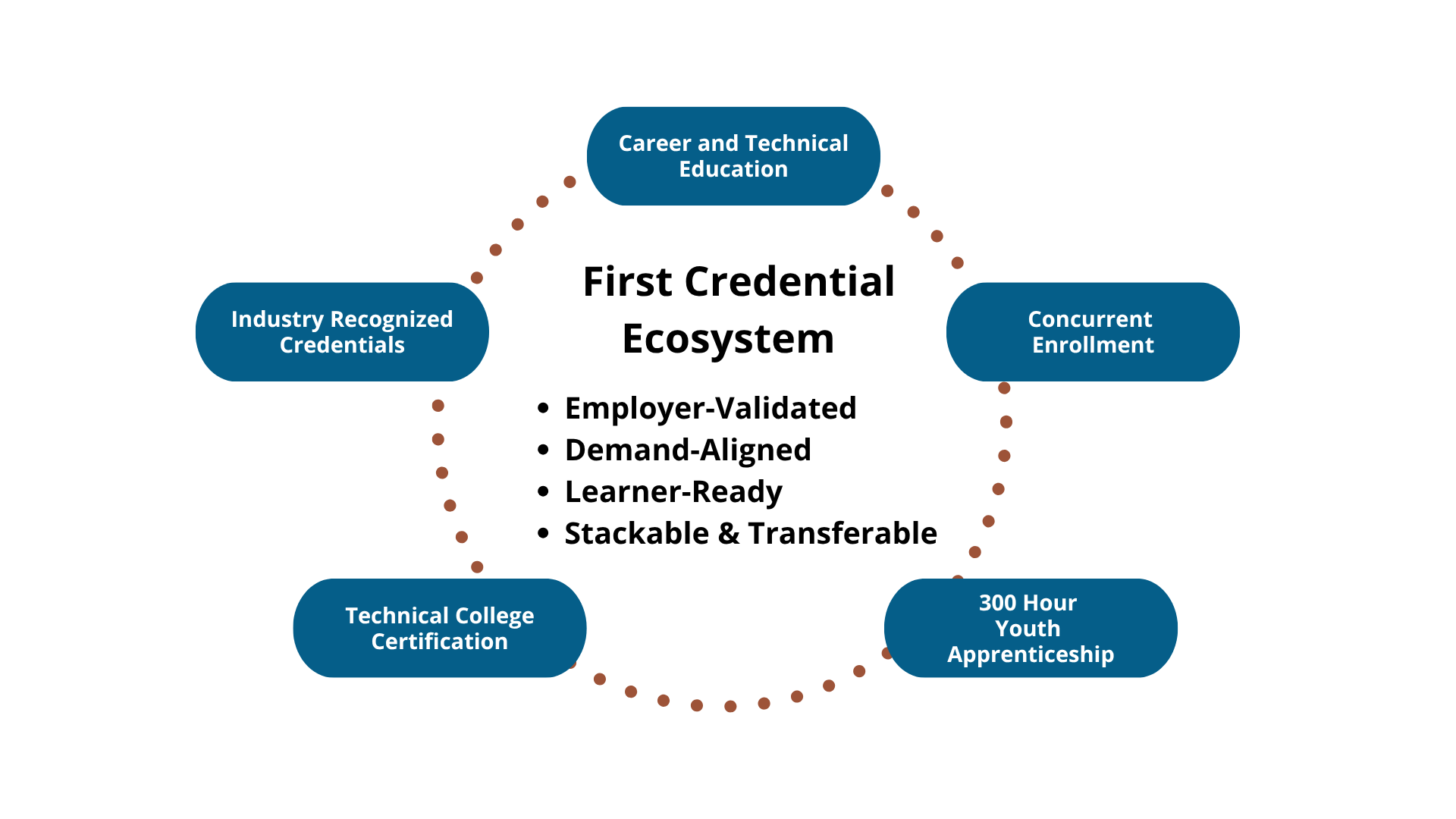
The Utah First Credential Program options provide multiple routes for learners to earn a First Credential, providing access points for all students and recognizing a critical balance for all students to explore employment, continued education, and career exploration. Each of the five routes meets the needs of a student as they navigate both career and advanced education options.
The Master Plan outlines the definitions, requirements, and recommendations for the quality design of each credential route. Each credential option is aligned for clear stackability, ensuring that students, employers, and higher education partners are clear and aligned on opportunities and actions beyond a First Credential.
Concurrent Enrollment:
- Earned by completing either:
- 12–18 core general-education credits across different GE categories, or
- a prescribed set of courses designated by the Utah Board of Higher Education.
- It is required that students earning a CE First Credential complete two door-opening
courses, one course from a selection of approved Quantitative Literacy courses and
one course from the selection of Writing courses. These categories are required because
they form the foundation for many postsecondary degrees and are required by many postsecondary
majors.
-
- Quantitative Literacy:
- MATH 1030 – Quantitative Reasoning
- MATH 1040 – Introduction to Statistics
- MATH 1050 – College Algebra
- Writing:
- ENGL 1010 – Intro to Writing
- ENGL 2010 – Intermediate Writing
- ENGL 2015 – Intermediate College Writing
- Quantitative Literacy:
-
Industry-Recognized Credential:
- A credential developed and offered or endorsed by a nationally recognized industry body.
- Any IRCs identified as a First Credential must represent substantial learning and academic rigor, generally equivalent to at least a semester of high school coursework, to ensure credibility and value-add to the student and institution.
Youth Apprenticeship:
- Earned by completing a minimum of 300 hours in an approved youth apprenticeship route.
- Each route must include structured, paid work-based learning combined with related classroom instruction that launches a student on the trajectory toward completion of a registered or approved unregistered apprenticeship program.
- Learn more: https://talentready.ushe.edu/trac/
Technical College Certificate:
- Earned by completing an approved certificate or a meaningful portion of a technical college certification (at least 300 hours) from a Utah public technical college.
- These certificates are competency-based, align to employer-validated program standards, and often embed industry certifications or licensure preparation.
Career and Technical Education Pathway:
- Earned by completing a state-approved program of study in a career and technical education field.
- These programs consist of a sequence of high school courses aligned to an industry sector and often embed opportunities for work-based learning. Many pathways also integrate industry-recognized credentials and/or concurrent enrollment credits, enabling students to gain both technical preparation and early momentum in higher education.
- Learn more: https://schools.utah.gov/cte/pathways/utah
Master Credential List
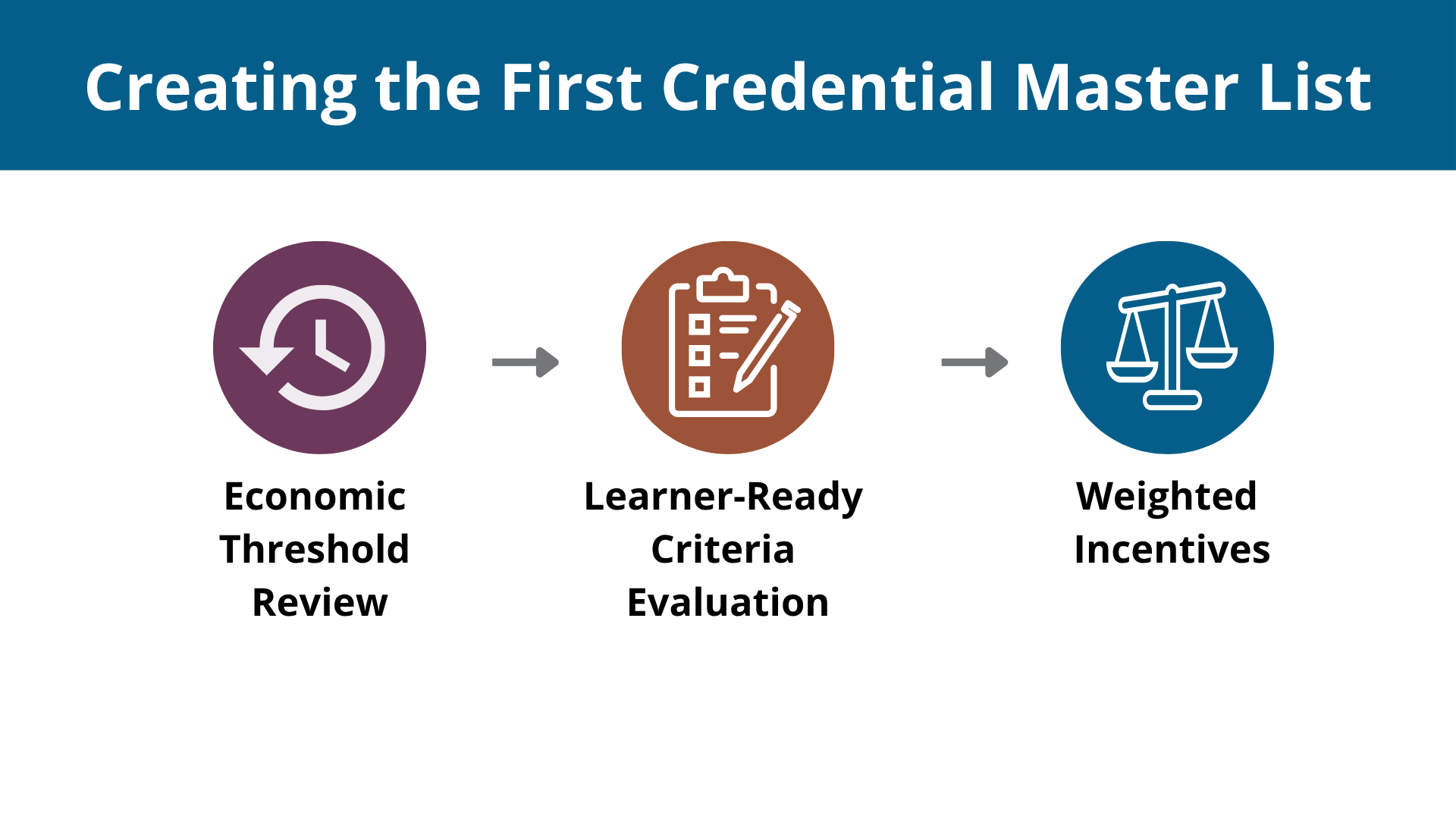
The Utah First Credential Program Master Credential List is the official, statewide inventory of credentials approved by the First Credential Review Committee and maintained by the Utah State Board of Education. The Master List is designed to provide LEAs, educators, students, and families with clear guidance on which credentials qualify as a First Credential. The Master List is a living resource, with edits to the official list on a three-year cycle. Edits are made to ensure alignment with Utah’s labor market needs and student opportunities.
The goal of the First Credential Master List is to identify and evaluate credentials of value and operationalize routes for students across Utah to earn credentials through one of the five defined First Credential routes.
Needs Assessment
The Utah First Credential Program Oversight Committee is tasked with establishing a needs assessment tool and a continuum of need. LEAs submit a completed needs assessment with their application which is reviewed, assigned a continuum placement, and an Implementation Plan is specified with requirements tied to the LEA’s needs and context.
First Credential Needs Assessment Guide
Step 1: Needs Assessment Fiscal Year 2027
The Needs Assessment must be submitted to firstcredential@schools.utah.gov by November 16, 2026 at 5:00 pm.
Implementation Plan
Every participating LEA must submit an Implementation Plan that includes:
- specific goals
- steps & timeline
- a detailed cost projection
- any additional elements identified by the First Credential Oversight Committee based on the LEA’s needs and context
The First Credential Oversight Committee reviews the Implementation Plan, provides feedback, directs technical assistance, approves qualifying plans, and awards implementation grants.
Additional details on the implementation plan will be provided here when finalized.
Scholarships
The purpose of the First Credential Scholarship is to support Utah students who earn their First Credential by providing financial assistance to enable continued learning. Funded through legislative appropriations and awarded by the Utah Board of Higher Education, the scholarship can be used at eligible degree-granting institutions and technical colleges for tuition, fees, books, and other approved educational expenses. It is valid for three years after high school graduation and can be combined with other state-sponsored scholarships.
The First Credential Oversight Committee is exploring models for students who earn a First Credential Scholarship that provide students with a tangible financial resource, serve as a valuable incentive, and are financially feasible for the state and education systems. The First Credential Oversight Committee will continue to explore options to most effectively use existing funding or align with additional state aid programs.
Students who complete any of the five credentialing routes will be eligible to earn a First Credential Scholarship beginning with the high school graduating class of 2027.
Oversight Committee
HB260 (GS 2025) established the First Credential Oversight Committee, which explicitly calls for the combined leadership of the following co-chairs to establish and lead the oversight committee:
- State Superintendent of Public Instruction
- Commissioner of Higher Education
- Governor's Education Advisor
The membership and responsibilities of Utah's First Credential Oversight Committee stipulate that the oversight committee must include representatives from industries such as professional associations and high-demand employers, as well as leaders from public education, higher education, technical colleges, workforce development, and Talent Ready Utah.
Since its formation in the fall of 2025, the oversight committee has convened through a series of meetings and collaborative planning sessions, facilitated by the National Center on Education and the Economy (NCEE), that have focused on examining credentialing priorities, evaluating workforce alignment, and developing Utah's First Credential Master Plan. Within these sessions, the elements of the Master Plan were developed.
Resources